Dharmasthala wedding decoration ideas for stage, mandap, entrance and dining: traditional flowers, lamps and fabric explained for every guest size.
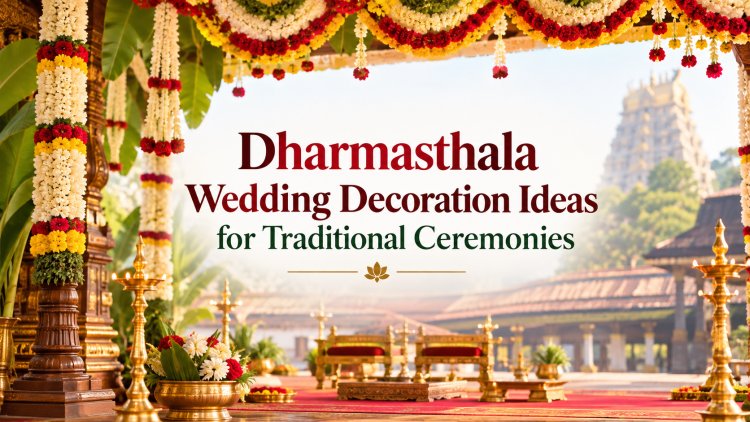
Dharmasthala wedding decoration ideas typically combine fresh flowers, banana leaves, brass lamps and traditional fabric to build a stage, entrance and dining setup suited to the ceremony's scale. The right approach depends on guest count, the chosen venue, and how closely the family wants to keep to traditional elements versus a more contemporary look.
A wedding at a Dharmasthala venue carries its own traditional character, and decoration plays a real part in keeping that character intact. Good decoration doesn't need to be elaborate; it needs to fit the ceremony, the guest count and the space actually available on the day. A stage built for 400 guests looks bare with 80 people around it, just as a compact mandap can feel cramped once a larger crowd gathers close for photographs.
Dharmasthala itself has long been a recognised pilgrimage and temple town in the Western Ghats, and weddings held here often carry that traditional setting into the decoration choices families make. Planning ahead and keeping traditional elements, flowers, lamps, fabric and rangoli, central rather than an afterthought is what separates decor that photographs well from decor that simply fills space.
How to Choose a Decoration Theme for a Dharmasthala Wedding
Most families planning traditional wedding decoration in Dharmasthala start by deciding between a fully traditional look and a lightly contemporary one that still respects the ceremony. Colour follows from that choice: red, maroon, gold and yellow remain the shades most associated with a Hindu wedding, since they read as auspicious and photograph well under both daylight and stage lighting, while green from banana leaves and foliage works as a natural base layer beneath brighter florals.
Flowers, fabric, lamps and traditional elements work best chosen together rather than one at a time, so the entrance, stage and dining area feel connected instead of decorated separately. A Dharmasthala wedding decor plan that repeats the same two or three elements across every zone reads as more coherent than one that changes look from area to area, and tends to age better in photographs than a design built around a passing trend.
Traditional Wedding Decoration Ideas to Consider
A traditional wedding draws on a small set of elements that have stayed consistent across generations, and combining them well matters more than using all of them at once. Some Hindu wedding decoration ideas worth considering in practice:
● Fresh flower decorations: marigold and jasmine garlands along the stage edge or mandap pillars
● Banana leaves and traditional foliage: laid along walkways as a natural, textured base
● Marigold and jasmine arrangements: combined for colour contrast rather than one flower alone
● Brass lamps and diyas: placed along the entrance path and stage edges, lit before guests arrive
● Traditional torans and floral strings: hung across the entrance doorway
● Silk fabric and decorative drapes: used behind the stage as a backdrop base under the flowers
● Rangoli and entrance decorations: placed at the threshold, refreshed on the morning of the event
A practical example: a family expecting around 150 guests might use marigold and jasmine garlands along a maroon fabric backdrop, banana leaf borders at the entrance, and one rangoli at the threshold, rather than spreading a smaller budget thinly across every corner of the hall. Rangoli in particular is treated as creating an auspicious space, which is why it belongs at the entrance guests actually cross, not as decoration elsewhere.
Dharmasthala Wedding Stage and Mandap Decoration Ideas
Traditional wedding stage decoration in Dharmasthala generally centres on the mandap, the structure under which the main ceremony takes place, built up with a few consistent components rather than one fixed design:
● Floral stage backgrounds: a fabric or floral wall behind the main seating, tall enough to read clearly in photographs
● Traditional mandap designs: a four-pillar structure in flowers, fabric, or both, sized to the stage rather than the largest available
● Flower pillars and garlands: framing each mandap post so the structure reads as decorated from every angle
● Fabric backdrops: layered behind florals for depth and colour without needing more flowers than the budget allows
● Brass lamps and traditional elements: placed at the mandap base and along the stage edge
Wedding mandap decoration ideas work best when kept proportionate to the stage's actual footprint. An oversized mandap on a small stage crowds the couple; an undersized one on a large stage looks lost against the backdrop. Confirming stage dimensions with the venue before finalising the mandap size avoids both problems and keeps the structure practical for wedding photography.
Wedding Entrance Decoration Ideas
The entrance is the first decoration guests actually see, which is why it's worth treating as its own zone rather than an extension of the stage design. A few elements consistently work well together here:
● Floral entrance arches built from the same flowers used on the stage
● Traditional torans hung above or beside the doorway
● Banana leaf and flower arrangements framing the entrance path
● Diyas and lamps lit along the walkway to the door
● Simple welcome boards, kept legible rather than overly decorated
● Traditional rangoli designs placed at the threshold itself
The goal is an attractive entrance without excessive decoration crowding the walkway; too many standing floral structures create a bottleneck exactly where photographs are usually taken.
Dining Area Decoration for a Traditional Wedding
Dining area decoration should stay simple and practical, since this is a working space where food service and guest movement need room. Light floral decoration at the entrance to the dining hall, a small floral piece or folded banana leaf accent on tables where the layout allows, and colours that echo the main stage theme are usually enough. Whatever is used, it should never obstruct guest movement between buffet counters and seating rows.
Decoration Ideas for Wedding Photography
Decoration and photography are planned together more often than families expect, since the stage backdrop, entrance arch and a couple photo area are usually the three most-photographed spots at any wedding. A floral wall behind the mandap and one clear, uncluttered corner set aside for portraits make a visible difference in the final photographs.
Reflective materials, foil backdrops and overly busy patterns tend to photograph poorly under flash and stage lighting, so simpler fabric and floral choices generally hold up better across a full day of photography. For a fuller look at planning photography around a Dharmasthala wedding, including entrance and couple-portrait timing, see the Dharmasthala wedding photography guide, which covers the photography side of the day in more detail than fits here.
Budget-Friendly Wedding Decoration Ideas
Prioritising the stage and entrance first is the most effective way to manage a decoration budget, since these are the two areas every guest sees and every photograph includes. Seasonal flowers cost less than out-of-season varieties and are usually just as visually effective when arranged well, and combining fresh flowers with reusable fabric or lighting stretches a budget further than fresh flowers alone.
Traditional lamps and diyas, once purchased, are reusable across multiple events. Low-visibility corridors and back-of-hall corners rarely justify the same decoration budget as the stage and entrance, and planning around the actual guest count rather than the venue's maximum capacity avoids paying for a scale of decor the function doesn't need.
Dharmasthala Wedding Decoration Ideas for Different Guest Sizes
How much decoration a wedding actually needs scales with guest count more than with budget alone. A breakdown that's held up across weddings of different sizes at Parijatha Conventional Hall:
|
Guest Count |
Stage & Mandap |
Entrance & Common Areas |
Photography Setup |
|
50–100 guests |
Compact backdrop, single mandap structure |
Minimal decoration, one floral arch |
Small dedicated photo corner |
|
100–250 guests |
Larger backdrop with layered flowers |
Fuller entrance arch, additional torans |
Separate photography area with backdrop |
|
250+ guests |
Full-scale mandap with flower pillars |
Expanded entrance and guest-path decor |
Multiple photo zones coordinated with guest flow |
Guest movement matters as much as scale. A 250-plus guest wedding needs decoration that leaves clear paths between the stage, dining area and parking rather than filling every available space, while a 50-guest wedding can afford a more concentrated, detailed look in a smaller footprint.
How to Coordinate Wedding Decorations With the Venue
Measuring available decoration areas before finalising any design avoids the most common last-minute problem: a backdrop or mandap structure that doesn't actually fit the space booked. Confirming where floral structures can be installed, checking stage and entrance dimensions, planning electrical and lighting requirements, and keeping guest movement areas clear all belong in the same conversation with the venue, rather than a decoration plan finalised independently. For families ready to take that next step, Parijatha Conventional Hall's venue details cover the hall dimensions and facilities a decoration plan should be built around.
Wedding Decoration Checklist for Families
A short checklist to confirm before decoration setup begins:
● ☐ Decoration theme finalised
● ☐ Colour palette agreed
● ☐ Stage and mandap design confirmed
● ☐ Entrance decoration planned
● ☐ Flowers ordered and confirmed
● ☐ Lamps and diyas arranged
● ☐ Rangoli design and placement decided
● ☐ Photography backdrop confirmed
● ☐ Dining area decoration planned
● ☐ Lighting requirements checked with the venue
● ☐ Decoration vendor confirmed and briefed
● ☐ Setup and removal timing agreed with the venue
Frequently Asked Questions
What are the best traditional wedding decoration ideas for Dharmasthala?
Fresh flower arrangements, banana leaf backdrops, brass lamps, floral torans and a simple mandap backdrop with marigold and jasmine remain the most commonly used traditional decoration elements for Dharmasthala weddings, chosen for their cultural relevance as much as their visual appeal.
Which flowers are commonly used for traditional Hindu wedding decoration?
Marigold, jasmine, rose and lotus are the flowers most commonly used in traditional Hindu wedding decoration, each carrying its own auspicious meaning, and are typically combined rather than used alone across the stage, entrance and mandap.
How can I decorate a wedding stage in a traditional style?
A traditional stage typically combines a floral or fabric backdrop, a mandap structure framed with flower pillars and garlands, and brass lamps placed along the edges, with the overall design kept proportionate to the stage's actual size rather than overcrowded with elements.
How much decoration is needed for a small wedding?
A wedding with 50 to 100 guests generally needs a compact stage backdrop, a single mandap structure and minimal entrance decoration, since a smaller guest count doesn't require the scale of decor a larger function would.
What should be considered before planning wedding decorations at a hall?
Confirm the hall's available decoration area, stage and entrance dimensions, electrical points for lighting, and any restrictions on installing floral structures before finalising a decoration plan, so the design fits the venue rather than needing last-minute changes.
How can wedding decorations be made more budget-friendly?
Prioritising the stage and entrance, using seasonal flowers, and combining fresh flowers with reusable fabric or lighting elements are the most effective ways to manage decoration costs without reducing visual impact in the areas guests notice most.
Plan Your Traditional Wedding in Dharmasthala
Choosing the right decoration for a Dharmasthala wedding comes down to matching the design to the ceremony, the guest count and the venue itself, rather than copying a fixed template regardless of scale. A 60-guest family wedding and a 300-guest function call for different decisions on stage size, entrance scale and dining layout. A well-planned setup, one that leaves guests room to move, photographs well, and keeps traditional elements central rather than incidental, makes the day noticeably more comfortable for everyone attending, not just the couple at the centre of it.
|
Planning a Traditional Wedding in Dharmasthala? Explore Parijatha Conventional Hall and check marriage hall availability for your wedding date. Call +91 94837 11122 or view the venue details to plan decoration around the space you'll actually be using. |
About the Author
Akhil Shetty is the CEO of Parijatha Conventional Hall, Dharmasthala, and has overseen wedding functions of varying scale at the venue, from small family ceremonies to large multi-day events.
Reviewed By
Chaithra SR is an SEO Executive at OneCity Technologies, Bangalore, with 5.5 years in digital marketing and 2 years of dedicated education-sector experience. She has worked on SEO and digital visibility campaigns for PU colleges and educational institutions across coastal Karnataka, including Excel PU College, Bright Horizon, and SVG. She holds a BE in Computer Science.
What's Your Reaction?